


1. What exactly is duplex stainless steel pipe?
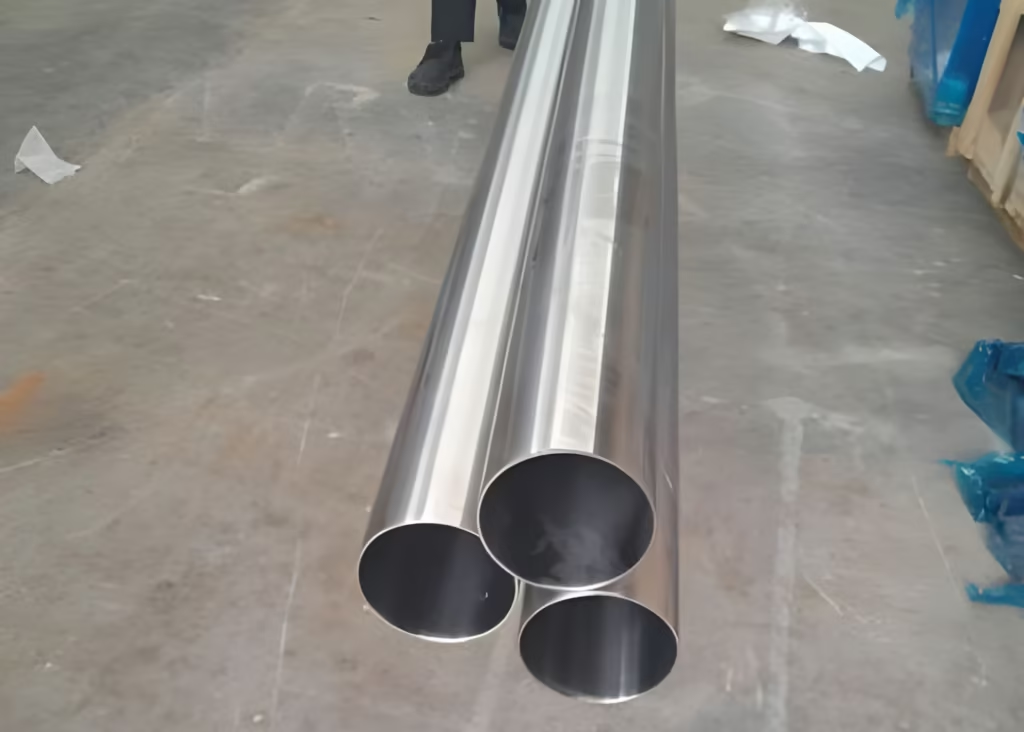
Duplex stainless steel Pipe is a type of stainless steel whose internal structure is roughly half austenite and half ferrite. This “two-phase” microstructure is why it’s called duplex. In pipe form, that structure gives you:
-
About twice the strength of common austenitic grades like 304/316
-
Very good resistance to corrosion, especially in chloride-containing and aggressive environments
A typical duplex pipe contains relatively high levels of chromium, often molybdenum and nitrogen, which together improve pitting, crevice, and general corrosion resistance.
So in one sentence:
Duplex stainless steel pipe is a high-strength, corrosion-resistant stainless steel pipe with a 50/50 austenitic–ferritic structure, designed for demanding, often corrosive service conditions.
2. How does duplex stainless steel pipe “work” inside?
If you could zoom into the metal under a microscope, you’d see two intertwined phases:
-
Austenite phase – brings toughness, ductility, and good weldability
-
Ferrite phase – brings high yield strength and resistance to stress corrosion cracking
The result of mixing them:
-
High strength
-
Yield strength is typically around 2× that of standard 304/316 stainless steels.
-
This often allows thinner wall thickness for the same design pressure, saving weight and sometimes cost.
-
-
Improved resistance to stress corrosion cracking (SCC)
-
Chloride SCC is a major failure mode in 304/316 piping in warm, salty, or chemically aggressive environments.
-
The ferrite in duplex significantly increases resistance to SCC compared with fully austenitic grades.
-
-
Strong pitting and crevice corrosion resistance
-
Higher chromium, molybdenum, and nitrogen levels increase the pitting resistance, which translates into better performance in seawater, brine, and chemical media.
-
Think of duplex as a “hybrid steel”:
like a hybrid car blending combustion and electric, duplex blends the strengths of two stainless families to cover more challenging conditions.
3. Main types and common grades of duplex stainless steel pipe
Duplex isn’t a single grade – it’s a family. Common sub-families and pipe grades include:
-
Lean Duplex
-
Example: 2101 (UNS S32101)
-
Lower alloy content → more economical
-
For mildly to moderately corrosive environments where you still want higher strength than 304/316.
-
-
Standard Duplex
-
Most common grade: 2205 (UNS S31803 / S32205)
-
Very good all-round corrosion resistance and strength
-
Workhorse grade for many oil & gas, chemical, and marine systems
-
-
Super Duplex
-
Example: 2507 (UNS S32750) and similar
-
Higher alloyed → even stronger corrosion resistance, especially in high-chloride, high-temperature brines
-
Used in offshore, subsea, and other critical process applications.
-
-
Hyper Duplex (more niche)
-
Higher alloyed and very high pitting resistance, for extremely aggressive environments.
-
Pipes are usually supplied to standards such as ASTM A790 (seamless and welded duplex stainless steel pipe) and related specifications for fittings and flanges.
4. Where is duplex stainless steel pipe used?
Anywhere the environment is too aggressive for 304/316, but full nickel alloys are too expensive or over-specified. Typical areas:
-
Oil & Gas (onshore and offshore)
-
Flowlines and pipelines
-
Injection lines
-
Topsides and subsea piping
-
Heat exchangers and risers
-
-
Chemical and Petrochemical
-
Acid handling lines
-
Chemical transfer and storage
-
Reactor and column piping
-
-
Marine & Desalination
-
Seawater cooling systems
-
Firewater lines
-
Desalination feed and brine lines
-
-
Power Generation & Energy
-
FGD (flue gas desulfurization) systems
-
Cooling water systems and condensers
-
-
Pulp & Paper / Industrial Plants
-
Liquor lines, bleach plants
-
Highly corrosive process streams
-
In these sectors, duplex pipe’s combination of strength + corrosion resistance + long service life often improves lifecycle cost versus austenitic stainless steel.
5. Key advantages of duplex stainless steel pipe
Summarizing the benefits that matter most in real projects:
-
High mechanical strength
-
Higher yield strength → thinner walls possible, lighter systems, easier handling and support design.
-
-
Excellent corrosion resistance
-
Strong resistance to pitting, crevice corrosion, and chloride SCC
-
Well suited to seawater, brine, and many chemical media.
-
-
Good fatigue and erosion resistance
-
Helpful in systems with fluctuating pressures, flow turbulence, or solid particles.
-
-
Better lifecycle economics
-
Initial cost is higher than standard stainless steel, but:
-
Less wall thickness
-
Longer service life
-
Lower rates of replacement and unplanned shutdown
→ often more cost-effective over the full life of the plant.
-
-
-
Reasonable weldability and fabricability
-
With correct procedures (heat input, interpass temperature, filler selection), duplex can be welded reliably.
-
6. Limitations and points to watch
Duplex is not a magic solution. Before specifying it, be aware of:
-
Temperature limits
-
Duplex performs best in a moderate temperature window.
-
At very low temperatures, toughness can drop.
-
At higher temperatures (typically above ~250–300 °C, grade-dependent), there is a risk of embrittlement and phase changes.
-
-
Fabrication sensitivity
-
Heat treatment, welding parameters, and cooling rates must be controlled to maintain the correct austenite–ferrite balance.
-
Poor fabrication can create sigma phase or other brittle phases, reducing toughness and corrosion resistance.
-
-
Higher initial material cost
-
Raw material is more expensive than 304/316.
-
However, total installed cost can still be competitive due to strength and thinner walls.
-
-
Not always the right choice
-
In very mild conditions, duplex may be over-engineered.
-
In extremely aggressive media (certain strong acids at high temperature), higher-alloy nickel-based materials may still be necessary.
-
7. How to decide if duplex stainless steel pipe fits your project
When reviewing materials, consider these practical questions:
-
What is the real corrosive environment?
-
Chloride content (ppm or %), pH, temperature, presence of H₂S or CO₂, oxygen, and contaminants.
-
Duplex becomes attractive as chlorides and temperature increase beyond the safe comfort zone of 316.
-
-
What are the design pressure and temperature?
-
Higher pressures and temperatures favor duplex due to its higher yield strength and SCC resistance.
-
-
What is the required design life and risk tolerance?
-
For systems where a leak or failure is very costly or dangerous, duplex can provide valuable risk reduction.
-
-
How mature are the fabrication and inspection capabilities?
-
Ensure fabricators are familiar with duplex welding and have appropriate procedures and qualification records.
-
-
Total cost, not just price per ton
-
Compare not only material price but also:
-
Wall thickness and weight
-
Number of supports and hangers
-
Expected maintenance and replacement
-
Downtime cost in case of failure
-
-
8. Three extended questions and clear answers
Q1: Is duplex stainless steel pipe always better than 304/316?
Short answer: No. It’s better in the right conditions, not in all conditions.
-
Where duplex is better:
-
Warm or hot chloride environments (seawater, brine, some chemical streams)
-
High pressures where thin-wall saving is significant
-
Systems where SCC and pitting are major concerns, and downtime is expensive.
-
-
Where 304/316 may be enough or better:
-
Mild, clean, low-chloride process media at moderate temperature
-
Non-critical systems where a minor corrosion rate is acceptable and budget is tight
-
Applications where very high formability with simple fabrication matters more than strength.
-
Think of duplex as the “step up” option: when 304/316 are technically marginal or risky, duplex moves the design back into a safe, economical window.
Q2: How do I choose between duplex and super duplex stainless steel pipe?
Focus on corrosion severity and design temperature:
-
Choose duplex (e.g., 2205) if:
-
Chloride levels are moderate (typical seawater systems, many oil & gas or chemical services)
-
Temperatures are not extremely high
-
You need strong corrosion resistance but not the maximum possible.
-
-
Choose super duplex (e.g., 2507) if:
-
Chlorides are very high (concentrated brines, high-salinity produced water, certain desalination streams)
-
Temperature is higher and still within the super duplex limits
-
Failure consequence is very high, and you need extra corrosion margin.
-
A good practical approach:
-
Map your environment (chlorides, temperature, pH).
-
Check guideline diagrams or pitting resistance ranges for candidate grades.
-
Compare lifecycle cost, not just initial material price – super duplex is more expensive, but in some cases cheaper than failures or frequent replacement.
Q3: What should I pay attention to during fabrication and installation of duplex stainless steel piping?
To get the performance you’re paying for, the fabrication stage is crucial:
-
Qualified welding procedures
-
Use approved WPS/PQRs specifically for duplex.
-
Control heat input and interpass temperature to keep the right austenite/ferrite balance.
-
Use matching or slightly over-alloyed filler metals.
-
-
Post-weld inspection and testing
-
Visual inspection and dimensional checks.
-
Non-destructive testing (e.g., radiography or ultrasonic testing) for butt welds.
-
In critical systems: ferrite measurements, corrosion tests, or hardness checks as required.
-
-
Avoid contamination
-
Separate carbon steel and stainless work areas where possible.
-
Use clean tools, brushes, and grinding wheels dedicated to stainless to prevent iron contamination.
-
-
Pickling and passivation
-
After welding and forming, proper cleaning and passivation restore corrosion resistance at welds and heat-affected zones.
-
-
Operational considerations
-
Start-up and shutdown procedures should respect temperature limits.
-
Avoid long exposure to temperatures that promote sigma phase formation.
-



2 Comments
tclottery
👍️👍️👍️
Chen Jia Xin
This article perfectly solved my problem.